
Anykščių vynas marks 100 years – from first barrels in Anykščiai to a symbol of Lithuanian winemaking
One of the oldest names in Lithuania’s beverage industry is celebrating a remarkable milestone this year – Anykščių vynas turns 100. For generations of locals, the anniversary means far more than a number – it reflects a craft, with knowledge and winemaking traditions carefully nurtured and passed down as a valuable heritage.
“The Anykščiai Pinewood, Puntukas Stone, Beacon of Happiness or Voruta Hillfort – this region has a strong identity. Our factory is also a fascinating part of its story,” says Liubovė Rebiatnikova, Head of Production at Anykščių vynas. She notes that the winery, owned by MV GROUP Production, has lived through different periods of Lithuanian history, economic shifts, and technological transformations.
“For me and my colleagues, this centenary brings a deep sense of pride – many people have been connected to the company for generations, while their parents or even grandparents have worked here” she adds.
Centenary marks are already appearing on wine packaging produced in Anykščiai, while the official celebration will take place in autumn alongside the traditional Apple Festival. The factory is also planning to open its doors to residents and visitors, inviting them to explore the spaces of Anykščių vynas.
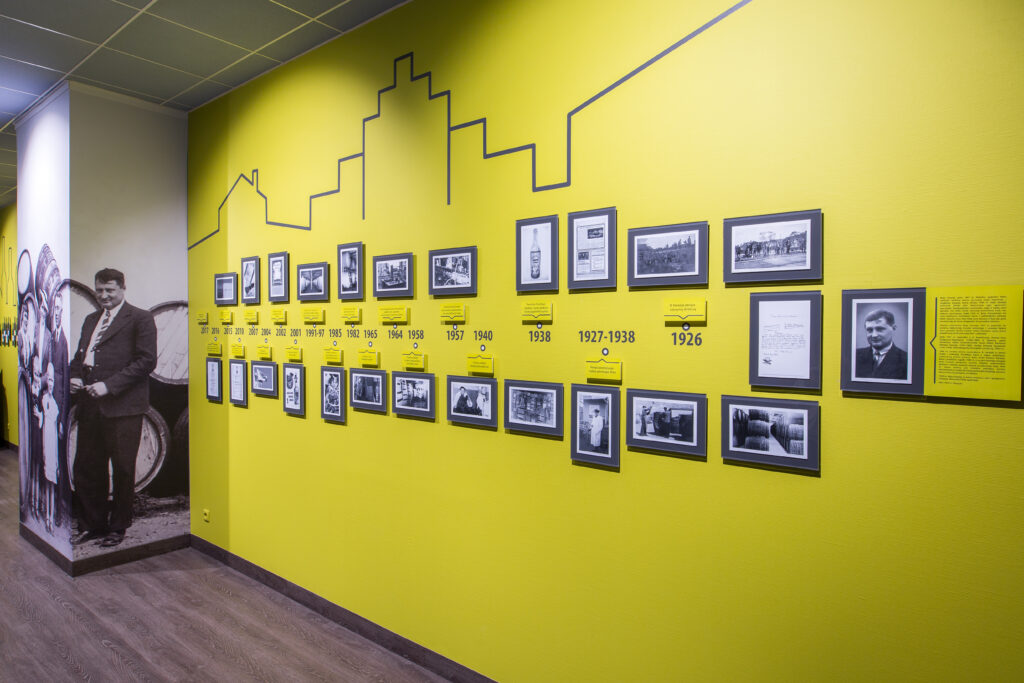
A bold beginning in Lithuanian fruit winemaking
At the visitor center, guests can discover numerous stories about one of Lithuania’s most renowned winemakers, Balys Karazija. A legendary figure, he was known not only for his expertise in production technologies but also for his inventive business decisions. His ambition, determination, and craftsmanship brought Lithuanian products recognition even in France.
The beginnings, however, were modest. In 1926, agronomist B. Karazija produced his first apple wine in the cellar of a rented house, establishing “B. and J. Karazija Fruit Wine Workshop.”
As the business grew, it became clear that his idea was not only bold but truly innovative – producing wine not from grapes, but from fruits and berries grown in Lithuania. Within just over a decade, the small workshop evolved into a factory, and its products gained recognition beyond the country’s borders. One of the most notable achievements came in 1938, when Anykščiai strawberry wine won the top prize at an international exhibition in Paris. A year later, annual production had already reached 900,000 litres. Today, the factory produces more than 4 million litres annually.
According to L. Rebiatnikova, Anykščių vynas remains one of Lithuania’s oldest producers of fruit and berry wines. Local winemakers shaped a national tradition, proving that high-quality wine can be made not only from grapes, but also from apples, currants, and strawberries.
Tradition stronger than turning points in history
The factory’s history is closely tied to the development of Lithuania’s entire beverage industry. Over the past century, Anykščių vynas has navigated nearly all major historical turning points of the 20th century – from changing political systems and legislation to technological evolution.
Yet long-standing traditions and employee dedication have helped overcome every challenge. Whenever possible, the company continued to innovate, expand its portfolio, and respond to market trends.
“Despite all the changes, we have preserved our core principles – producing beverages from local fruits and berries. Some recipes and production methods are passed down from generation to generation – through daily work, respect for the craft, and responsibility for quality. Today, we stand out by combining modern technologies with traditional fruit winemaking knowledge,” says Rebiatnikova.
A living link between beverage industry legends
The story of Anykščių vynas is an important part of Lithuania’s beverage industry. This is well understood by its owner, MV GROUP Production, which also includes Alita, Stumbras, and Gubernija factories.
“The long history of the factory proves that Anykščių vynas adapts seamlessly across different historical periods. Today’s team of professionals is able to enrich unique production traditions with new creative solutions and develop ambitious ideas using the latest technologies,” says Algirdas Čiburys, CEO of MV GROUP Production.
He believes that the knowledge, skills, and persistence passed down through generations are key elements of the company’s success. This year, consumers will see new flavours of non-alcoholic Voruta wines, produced at Anykščių vynas, aligned with global trends in fruit and berry wines.
The portfolio has already been expanded with a new addition to the Blossom line – a non-alcoholic wine with apple, cherry, and rosehip flowers notes. Designed for summer enjoyment, it complements the already popular non-alcoholic Winterspice, widely enjoyed during the colder season.
A. Čiburys highlights that Voruta is the most popular wine brand in Lithuania within the natural fermentation category. Its success is driven by consistent brand development and attention to consumer needs.
“Non-alcoholic wines produced in Anykščiai are gaining momentum. Consumers value both our innovations and the local origin of our products, which is why we introduce new offerings every year – including those created especially for this anniversary,” he concludes.
Anykščių vynas presents the city with a Japanese cherry orchard

Expansion to the capital following success in Šiauliai: „Alaus kronikos. Gubernija“ opens branded store in Vilnius
Rocker and pop diva duo: what common ground did Samas and Jazzu find in the Gubernija challenge?
